The State of Freight Scheduling Tech in 2026
A buyer's guide

Scheduling is one of the highest-volume, most operationally intensive workflows in freight. The right automation solution can drive massive efficiency gains, accelerate carrier sourcing, and improve service. The wrong one locks you into slow rollouts, low adoption, and limited ROI.
We talk to ops and tech leaders at large brokers and carriers every day. Everyone is evaluating “scheduling automation,” but it’s hard to separate signal from noise.
So, here’s a simple 3-question framework you can use as you look at potential scheduling partners:
Do I want a scheduling autopilot (or just a copilot)?
Do I need to automate rescheduling or complex workflows?
Do I want outcomes-based pricing (pay-per-appointment)?
Spoiler: If the answer to any of these questions is “yes,” you should consider HubFlow. Feel free to skip ahead to our conclusion and product comparison table, or read on to explore each question in more detail.
Question #1: Do I want a scheduling autopilot (or just a copilot)?
This is probably the most important decision you’ll make – there are major differences between copilot and autopilot scheduling products.
A copilot relies on human operators to trigger scheduling tasks. Think of a “scheduling button” inside an inbox or a TMS. Scheduling doesn’t happen until an operator presses the button, often after providing key inputs such as the desired appointment time.
An autopilot can work autonomously without waiting for human input. Think of it as a coworker: the autopilot takes actions by itself, asks for help if it gets stuck, and learns over time.
The key difference is that the autopilot removes humans from the loop. This creates a massive difference in ROI, which is why HubFlow is built as a scheduling autopilot.
If a human is still in the loop, you don’t get:
Faster scheduling throughput (because you still need a human to trigger scheduling)
Real OpEx reduction (because you still need a human to babysit the “automation”)
Advanced use cases like rescheduling (because if you can’t schedule a shipment without a human, you definitely can’t reschedule it)
You’ve just moved the work around to a new platform and confused your operations team.
Why companies choose a copilot:
You’re adopting a broader copilot platform
You want tight human control over appointments long-term
You deal with a lot of email tenders / haven’t automated load-building yet
Why companies choose an autopilot:
You want real automation and ROI now
You want best-in-class tools for each step of the load lifecycle
You want to scale without adding headcount
HubFlow’s scheduling autopilot helped EASE Logistics cut their Client Services team in half while growing freight volumes, increase scheduling velocity by 3–10x, and reach 95% touchless scheduling.
Question #2: Do I need to automate complex workflows or rescheduling?
Once you’ve decided on copilot vs. autopilot, the next question you’ll need to answer is how complex your scheduling is.
In 2026, basic scheduling is table stakes. Sending a single email or booking one stop in a portal is scheduling on easy mode. The real work – and ROI – comes from automating scheduling once it gets to “hard mode”.
“Hard mode” scheduling is probably where your operations team spends most of their time today:
Planning multistop loads
Complex workflows that cut across portal + email + phone
Reschedules, exceptions, and constant changes
That’s where most scheduling tech falls apart, but it’s where HubFlow’s AI-native approach to scheduling shines. Check out some examples of complex workflows that HubFlow handles today.
For many large brokers and carriers, rescheduling is the Mount Everest of complex workflows. With enterprise shippers, rescheduling is a separate process, and can require navigating:
Shipper approvals
Complex rules on date changes and must-arrive-by-dates (MABDs)
New portal workflows
This additional complexity makes automating rescheduling difficult, but also especially valuable. For some large accounts, 50-60% of shipments wind up getting date-changed – rescheduling is the rule, not the exception.
Rescheduling also allows brokers and carriers to optimize their appointments for truckload transit and:
Reduce carrier costs
Improve carrier procurement + matching
Increase on-time pickup/delivery and other service metrics
For Edge Logistics, HubFlow has successfully deployed fully automated rescheduling for a large enterprise shipper, driving meaningful improvements in service and cost per load on thousands of shipments with zero operational overhead.
Automated rescheduling transforms scheduling from a single, rigid workflow into a dynamic lever your team can pull to improve carrier relationships, service, and profitability. If you’re interested in this, HubFlow is the only provider of automated rescheduling on the market today.
Question #3: Do I want outcomes-based pricing (pay-per-appointment)?
The pricing model isn’t just about what you pay: it also provides insight into the maturity of the technology you’re buying, and can create powerful incentives that make or break a deployment.
Most modern AI companies have adopted usage-based pricing. HubFlow goes further, to outcome-based pricing: you only pay when we successfully schedule an appointment. In every deployment, we literally bet on our ability to execute for you.
Why this matters:
You don’t have to make a large upfront commitment
You have confidence that our product is ready and able to do the work on Day 1
You can scale up your deployment once you see HubFlow working
More importantly, outcomes-based pricing aligns our incentives:
We win together – we get paid only when you get ROI
We both push to deploy fast and drive adoption
You’re not paying for unused scheduling capacity
Many tech providers will push you toward a long-term contract of 2+ years. While we believe in the value of long-term partnerships, we don’t understand why these strict contract terms are necessary if the underlying technology is easy to implement, scalable, and valuable. If a tech provider only offers annual contracts, they are signalling that their product requires a lot of work to set up and might not deliver on the promised ROI even once it’s live.
Rule of thumb: if the pricing model looks like 2015, the tech probably does too.
For Emerge, we completed a proprietary TMS integration in 3 weeks from contract signing to first shipments live and scheduled. We’ve since rolled out to over 3 dozen shippers with them.
Conclusion + Comparison Table
If you answered “Yes” to any of these questions, HubFlow is the only product on the market that:
Schedules as an autopilot at scale (see our case study with EASE)
Handles complex, multi-step scheduling workflows (see our list of advanced features)
Automates rescheduling (see our case study with Edge Logistics)
Offers pay-per-appointment pricing to drive quick deployment (see our case study with Emerge)
Here’s how we stack up with the competition:
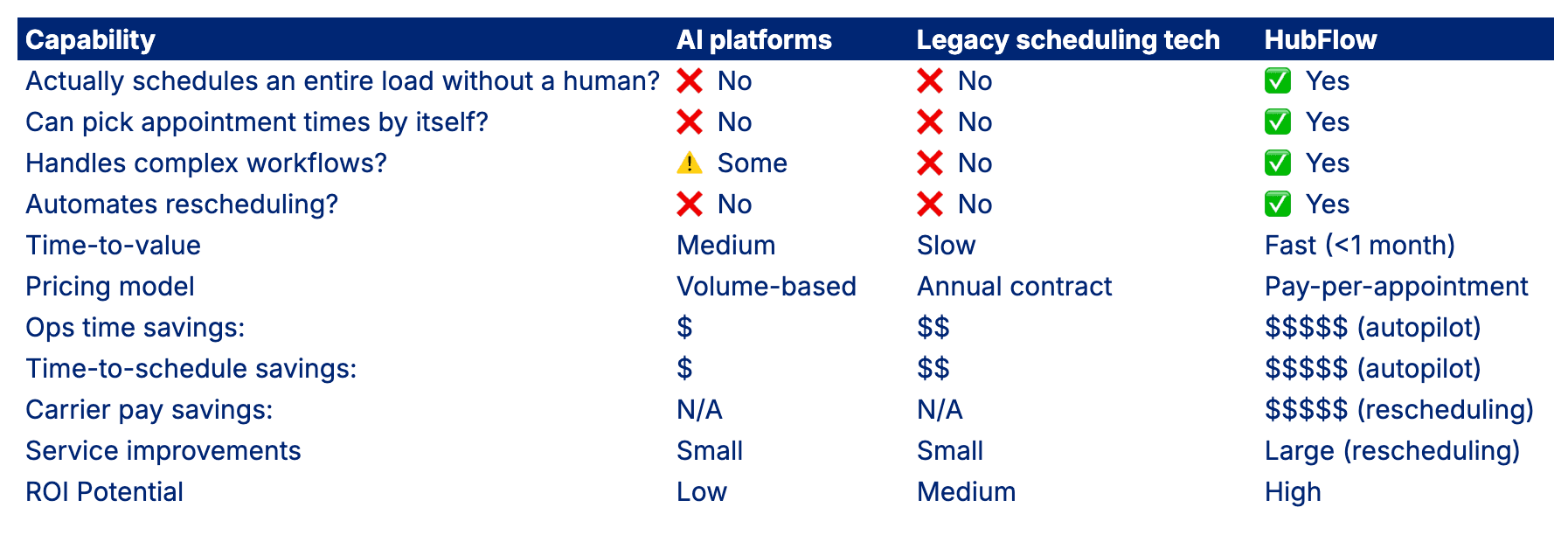
Evaluating scheduling products
Don’t just watch a demo.
Share data and measure automation coverage out of the gate and on Day 30/60/90
Run real loads through the system to test autopilot capabilities
Ask to see the rescheduling, complex workflows, and product features your team actually needs.
A good scheduling partner will welcome this level of scrutiny, and we’ve never lost a head-to-head evaluation.
Red flags to watch out for:
Copilot being sold as an autopilot → No real ROI, just an annoying workflow change
Complex workflows that are “on the roadmap” → They rarely get built, but ours are live and in production.
Long-term contracts with misaligned incentives → You’re signing a 2-year contract and assuming all the adoption risk. 1) Don’t do that, and 2) Talk to us instead.